The AI SDLC Playbook
AI in the software development lifecycle is an operating model change, not a tooling purchase. Authoring code got cheap. Verification, integration, and merge capacity are now the constraint, and this is the operating manual for the rules, roles, and guardrails that make the gain durable instead of a spike that reverses.
Start with the six signs that tools have outrun process, the ten rules and the three eras. Then find your level, open the path for your role and use the map of twenty pages to go deep on the part you own.
Why This Is an Operating Model Problem
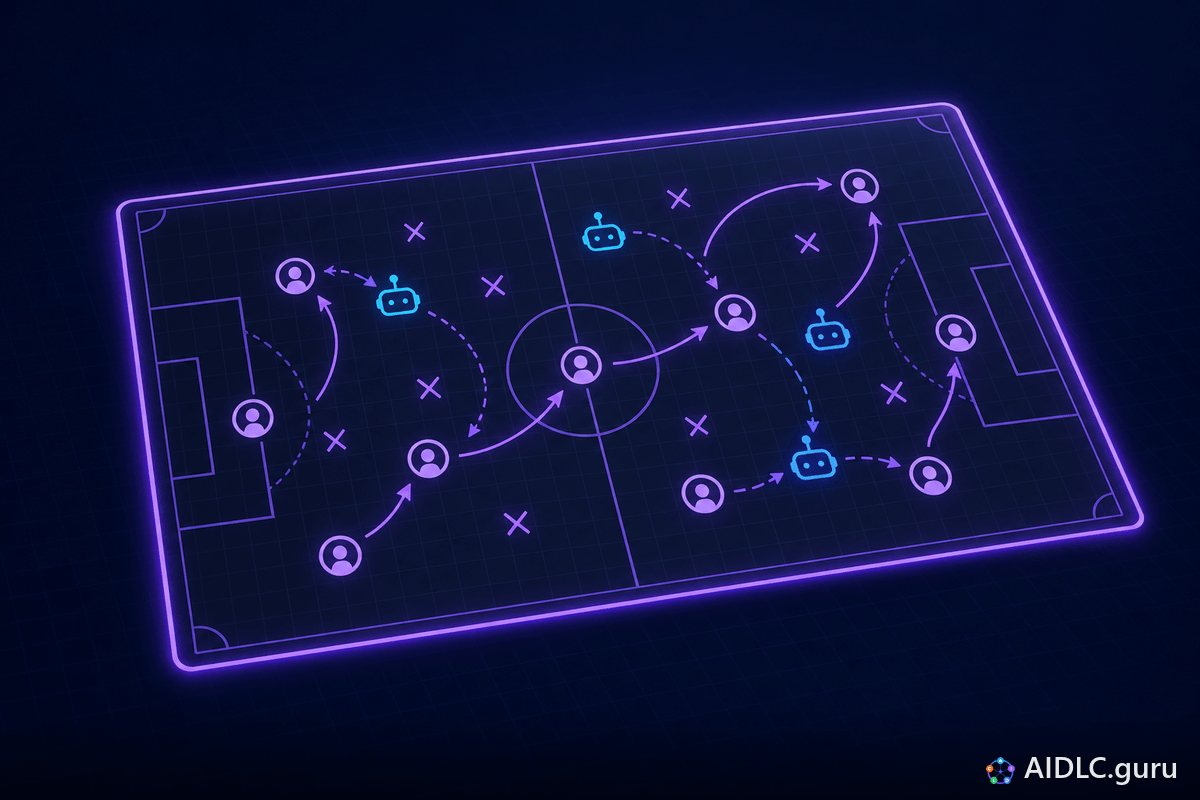
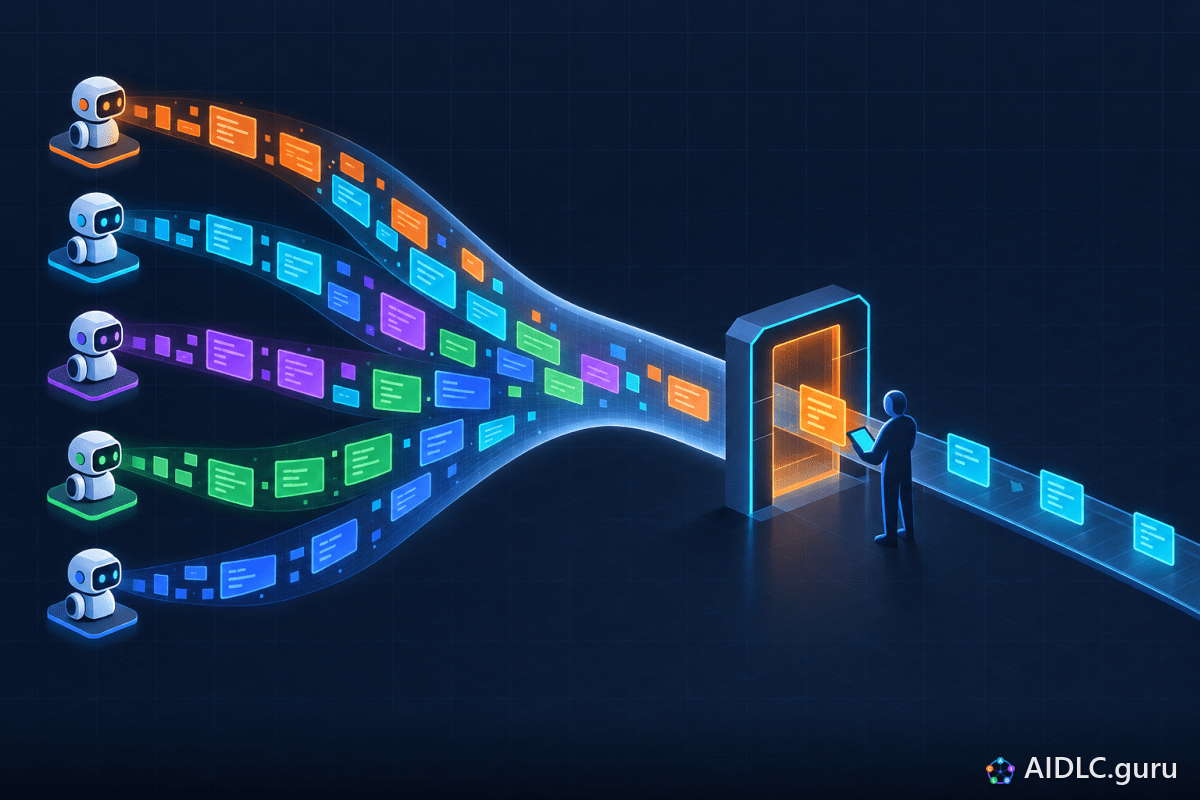
Licenses were never the hard part. Once an agent can produce a working diff in minutes, the bottleneck moves downstream to whoever has to read, verify, and merge it. Organizations that redesign review, testing, and merge capacity around that constraint capture a real gain. Organizations that bolt agents onto the existing authoring step just double their pull request volume and drown in it.
That is the thesis behind every page in this Playbook. It is not a claim that AI does not help - it demonstrably does at the level of a single task. It is a claim that individual acceleration does not automatically become organizational throughput, and that the difference between the two outcomes is deliberate operating design, not the model you picked.
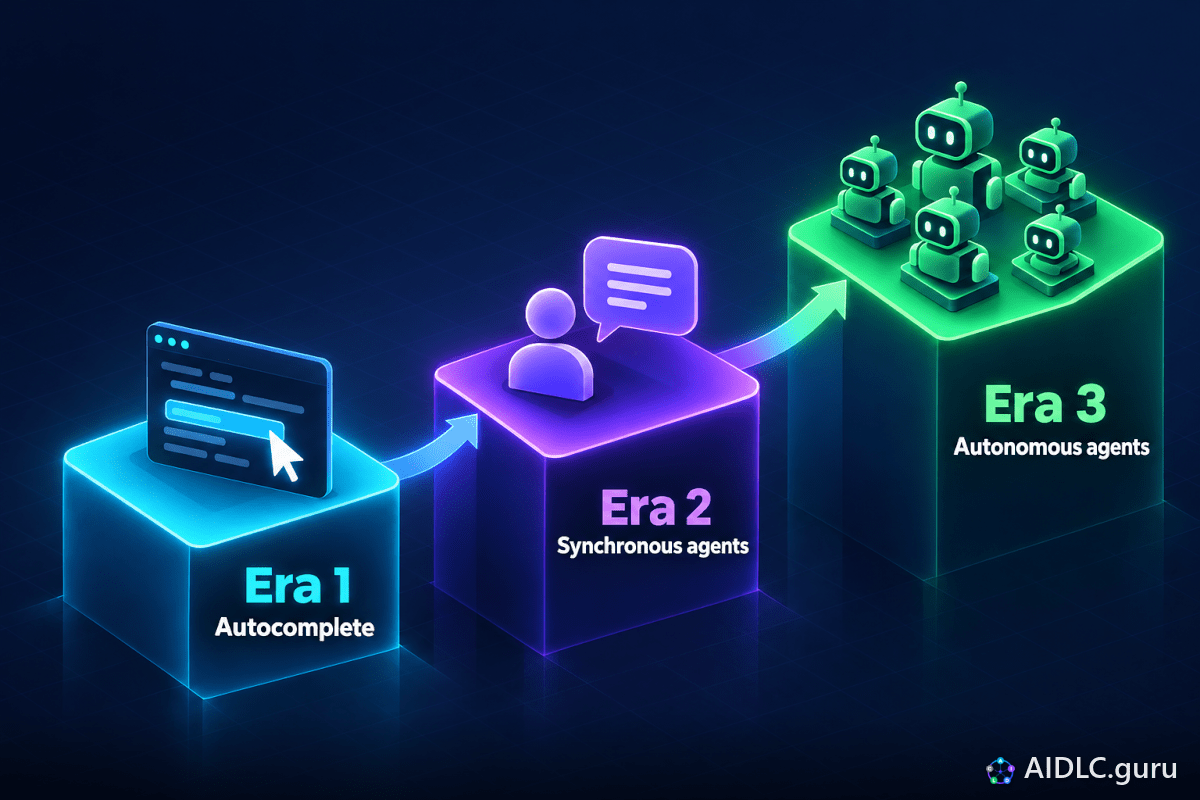
Software development has already moved through three eras of AI assistance, each shifting more of the work to the agent and more of the job to the human who directs and checks it. The rest of this guide is an operating model for the era the industry is in now.
Six Signs You Need an Operating Model
Nobody decides to run AI without an operating model. It happens one license at a time. If two or more of these describe your organization today, the tools have outrun the process, and the page beside each sign is where to start.
The review queue keeps growing
Engineers say they are faster, yet pull requests wait longer and delivery has not moved.
The Productivity ParadoxNobody knows which tool may see which data
People use what they like, with whatever they paste into it, because no policy says otherwise.
Governance Before ScalePull requests are approved without comment
Reviewers are tired, the diffs are long and plausible, and approval has become a reflex.
AI Code Review at ScaleCoverage rose and escaped defects did not fall
The tests run the code without checking the result. It looks thorough and catches little.
Hidden RisksAgents run on a developer's credentials
An agent in the pipeline has no identity of its own, so nobody can say what it was allowed to do.
Agents in the PipelineLeadership sees adoption, not outcomes
The report counts licenses and AI-written lines. No baseline was taken, so nothing can be compared.
Measuring ImpactTen Rules
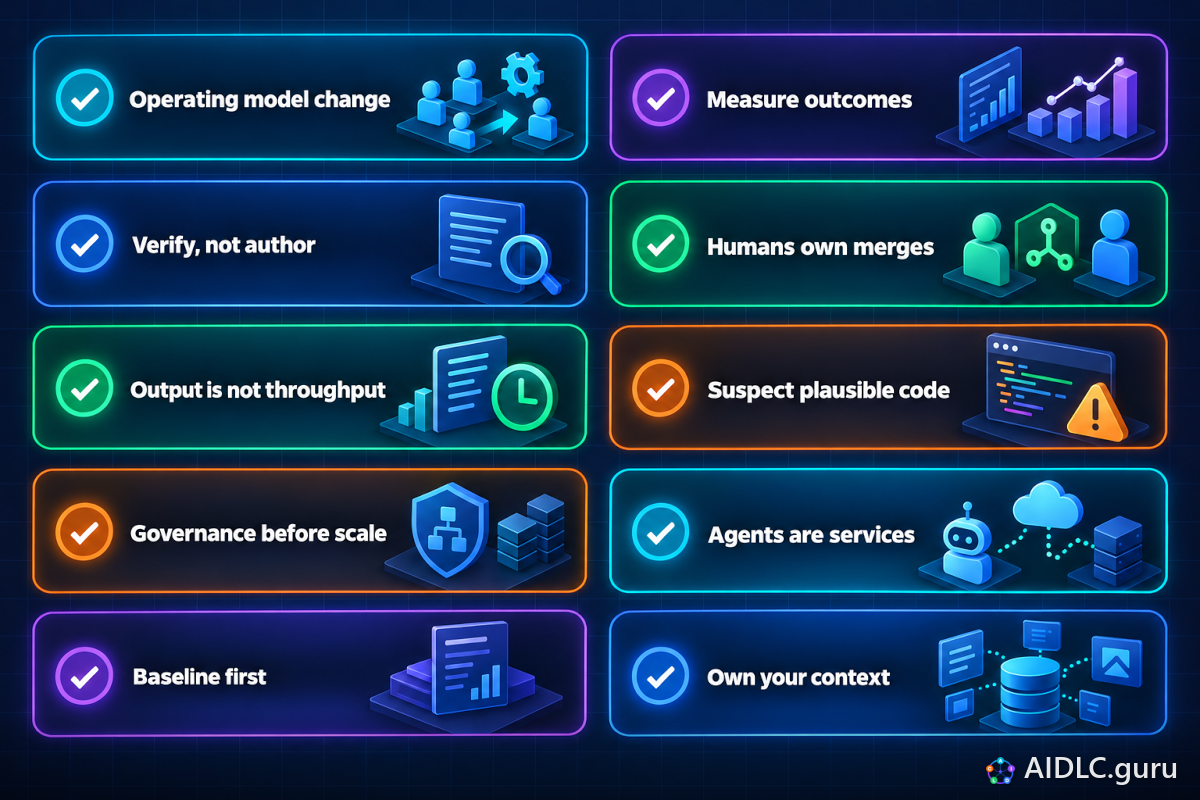
An operating model change, not a purchase
Licenses are the cheapest and least important part of putting AI into the SDLC.
Authoring is cheap. Verification is the constraint.
Design review, test, and merge capacity before you scale how much code gets generated.
Individual output is not organizational throughput
Every serious dataset since 2024 shows the gap. Assume it applies to you until your own numbers say otherwise.
Governance before scale
Retroactive policy lands after habits have formed and costs more to enforce.
Baseline before adoption
A number without a pre-AI baseline is a story, not evidence.
Measure outcomes, not activity
Cycle time, change failure rate, escaped defects, and review latency. Not adoption percentage, not AI-authored lines.
Humans own merges
An agent never holds merge authority on a protected branch. Every production change has a named human approver.
Hold AI code to the human bar, with more suspicion
AI output is plausible by construction. Plausible is not correct.
Agents are services
They get an identity, a permission scope, a sandbox, a budget, and hard rules, same as any other workload.
The compounding asset is your context, not the model
Repo instructions, review rules, skills, evals, fixtures, and evidence are owned. Models are rented and will be swapped.
Three Eras of AI in Software Development
| Era | Window | What it looks like | Developer role | Unit of trust |
|---|---|---|---|---|
| Autocomplete | 2021 to 2023 | Keystroke-level suggestions, tab to accept (Copilot preview June 2021, general availability June 2022) | Full control of every line | The line |
| Synchronous agents | 2023 to 2025 | Chat and agentic IDE loops, one task at a time, human watching (ChatGPT, Cursor, Claude Code, Copilot Chat) | Human in the loop, directing | The diff |
| Autonomous agents | 2025 onward | Agents run for hours in CI and cloud sandboxes, open pull requests unattended, run in parallel fleets (Copilot cloud agent, Codex cloud, Claude Code GitHub Action, background agents) | Defines problems, approves plans, reviews artifacts and evidence | The plan and the evidence pack |
What Changed in 2025 and 2026
- Agents moved into CI. GitHub's Octoverse 2025 report found the Copilot coding agent (renamed cloud agent in April 2026) authored over one million pull requests between May and September 2025.
- By March 2026, GitHub reported more than one in five code reviews on GitHub was a Copilot review, 60 million in total. By September 2026 GitHub was previewing AI review approvals that count toward required reviews.
- Vendors now report a majority of their own code as AI-authored. Anthropic said more than 80 percent of code merged to production in May 2026 was authored by Claude. Google said more than 30 percent of its code was created with AI help in April 2025. Treat both as self-reports with different definitions - assisted versus autonomous, written versus merged.
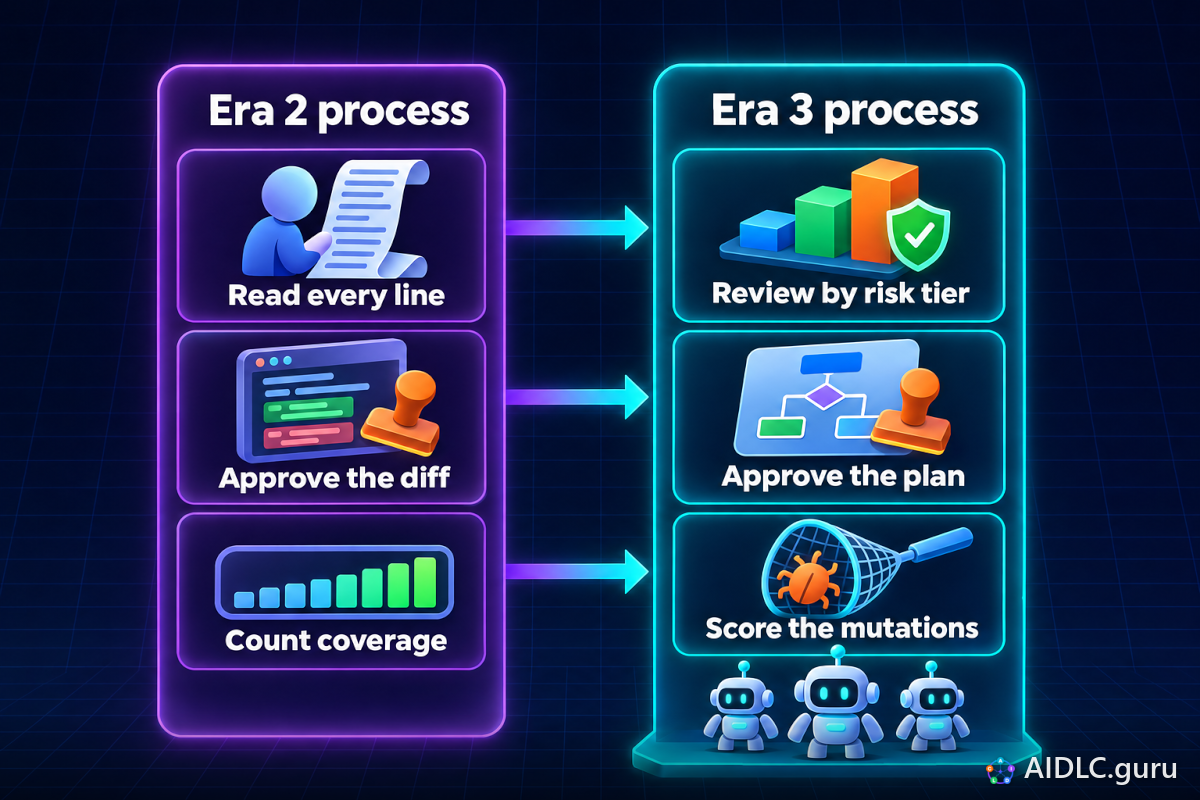
- Era 2 practice, where a human reads every line, does not scale to Era 3 volume. Era 3 practice - plan approval, risk-tiered review, generated evidence, mutation-scored tests - is not yet common. Most organizations are running Era 3 tooling with Era 2 process, and that gap is where the common failure patterns live.
Era 3 Tools, Era 2 Process: Closing the Gap
Most organizations bought Era 3 tooling and kept Era 2 process. The table shows what each practice looks like on both sides of that gap, and which page of the Playbook moves you across it.
| Practice | Era 2 process | Era 3 process | How to get there |
|---|---|---|---|
| Review | Read every line of every pull request | Review by risk tier, so effort follows what a change could break | AI Code Review at Scale |
| Approval | Approve the diff, after the code exists | Approve the plan, before any code is written | Engineering Practices |
| Test quality | Count coverage | Score the mutations on critical modules | Engineering Practices |
| Evidence | Reconstructed by hand when an audit asks for it | Generated with every change and attached to it | Security and Compliance |
| Agents | A tool on a developer's machine, using that developer's access | A service with an identity, a permission scope, a sandbox and a budget | Agents in the Pipeline |
| Measurement | Adoption and AI-authored lines | Outcomes against a baseline taken before adoption | Measuring Impact |
Where Are You Now? Five Levels in One Minute
The Playbook reads differently depending on where you start. Find the level that sounds like your team, then open the page beside it. The scale measures how safely AI is built into the way you work, not how much of it you use.
Guardrails introduced
Approved tools, basic data rules, and review standards on paper.
Read next: Engineering Practices
Measured and standardized
Consistent cross-team metrics, risk-tiered review, and scoped agent identities.
Read next: Agent Orchestration
Governed and optimized
Governance embedded in the engineering workflow, with automated checks and continuous improvement loops.
Read next: Research Library
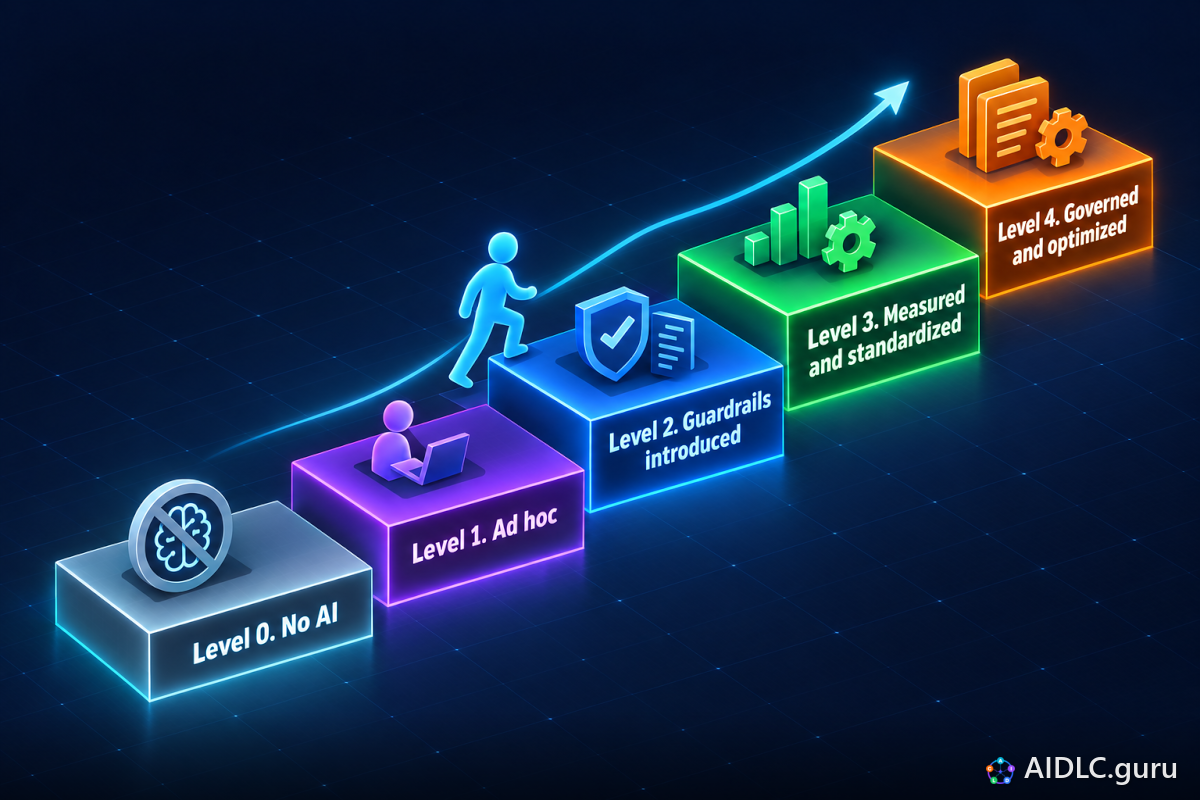
Not sure which level is yours? The Maturity Model has a twelve-question self-assessment that places you.
Where AI Touches Every Phase
Risks and guardrails are phase-specific. A blanket policy either over-restricts or under-protects.
| Phase | Strong at | Weak at | Guardrail | Who owns the outcome |
|---|---|---|---|---|
| Requirements and design Analyze / Ideate | Drafting PRDs, stories, acceptance criteria, design options, architecture notes, ambiguity checks against a spec | Knowing what the business actually wants; tradeoffs it was never told about | The ticket becomes a machine-readable contract (see Templates); a human signs the intent | Product owner |
| Coding Develop | First drafts, boilerplate, tests, migrations, refactors with a clear target, unfamiliar APIs | Your actual edge cases, your architectural conventions, current API versions, production-grade error handling | Repo instruction file, plan approval before implementation, small pull requests | Author (human or named agent identity) |
| Code review Develop | First pass: formatting, naming, anti-patterns, obvious security flags, PR summaries, risk classification | Judgment calls needing domain or architectural context; knowing which rule matters here | Versioned review standards, risk-tiered routing (see AI Code Review at Scale), human approver required | Reviewer |
| Testing Launch | Unit tests, fixtures, edge-case enumeration, Playwright specs from acceptance criteria, contract tests | Tests that assert the right thing. AI writes tests that look thorough and assert nothing | Mutation testing on critical modules; coverage is not the gate, mutation score is | QA lead |
| CI/CD Launch | Pipeline config, build failure diagnosis, release notes, infra snippets, safe-class auto-repair | Anything where the cheapest path to green is weakening a test | Agent identity, hard rules (see Agents in the Pipeline), attempt limits, original failure log attached | Platform team |
| Release Launch | Change records, risk diffs, impact matrices, rollback plans, control mapping generated from the branch | Deciding whether to ship | Named human approver on every production merge | Release owner |
| Incident response Curate | Alert synthesis, log condensation, correlating deploys to errors, drafted status updates, timeline reconstruction | Deciding what to do under uncertainty; customer communication | Agent proposes, human acts; drafts are labeled as drafts | Incident commander |
| Postmortems Curate | Timelines, summaries, draft action items, pattern matching against past incidents | Blameless framing, organizational truth | Every escaped defect becomes a review rule (see Engineering Practices) | Engineering manager |
| Maintenance Curate | Dependency bumps, deprecation fixes, copy and internationalization, test backfill, documentation | Long-horizon structural refactoring; it will not do this unless told | Scheduled refactoring budget; track cross-file coupling and duplication | Tech lead |
Start Here by Role
Everyone needs the ten rules above. Past that, start where your role sits.
CTO, VP Engineering
Read The AI-Native SDLC, The Productivity Paradox, the Maturity Model, Governance Before Scale, Measuring Impact, the Cost Model, and Failure Patterns.
Engineering managers, staff engineers
Read Engineering Practices, AI Code Review at Scale, Agents in the Pipeline, Agent Orchestration, Security and Compliance, and the Rollout Playbook.
Individual contributors
Read Engineering Practices, Agents in the Pipeline, and Templates and Checklists for the day-to-day patterns.
Security, compliance, audit
Read Governance Before Scale, Security and Compliance, and Templates and Checklists.
Anyone about to quote a number
Read the Research Library first. Several widely circulated AI productivity figures are misattributed, and The Productivity Paradox is the single most misquoted finding in this field.
Enterprise and solution architects
Read How the Phases Connect for the handoffs and owners, Testing Strategy for where each test lives, and Building AIDLC Into an AI Engine for the reference architecture.
The Playbook as a Map
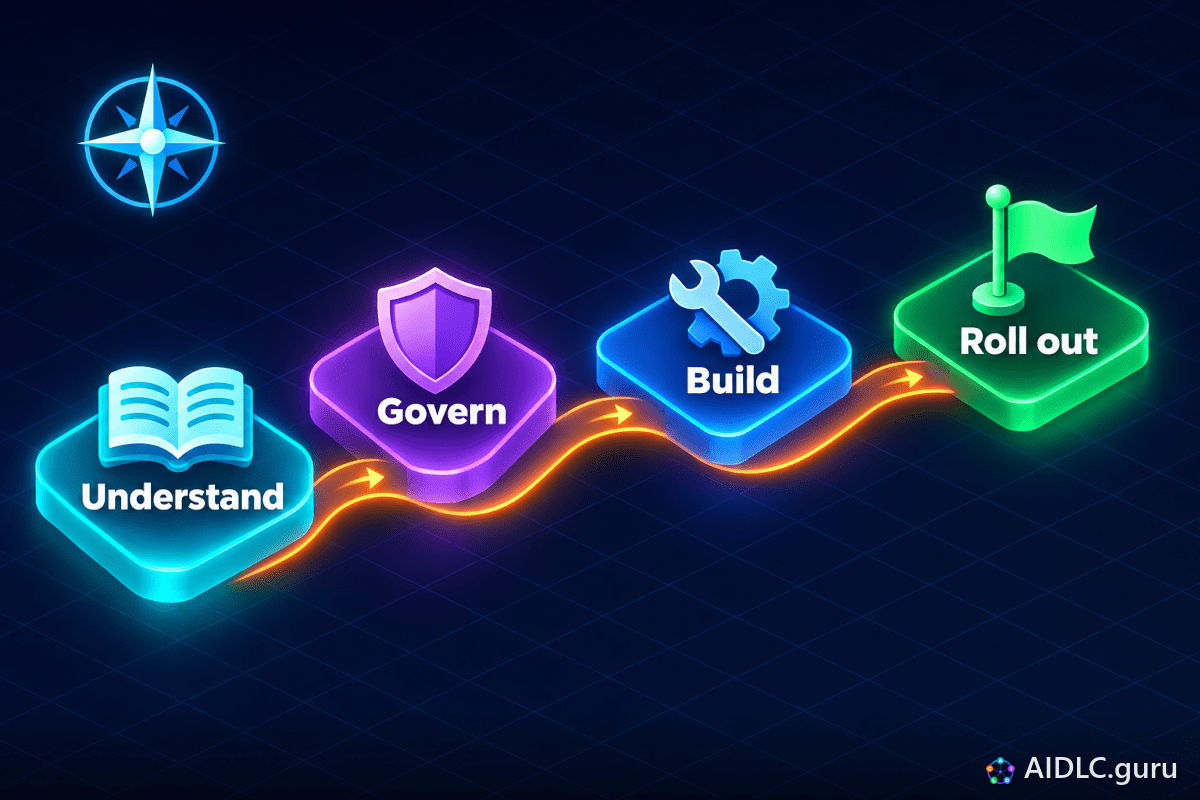
The pages fall into four groups, and the groups have an order: understand what is happening, govern it, build the practices, then roll them out.
What AI changes in software delivery, and what the evidence says.
The rules, the measures and the money, settled before scale.
The day-to-day engineering practices that make agent work safe to accept.
Taking it from one team to the organization, and the people side of doing so.
Questions the Playbook Answers
If you arrived with a specific question, start at the page that owns it.
| If you are asking | Start here |
|---|---|
| Our team is stuck in the old way. Where do we begin? | Crawl, Walk, Run |
| Engineers say they are faster. Why is delivery not? | The Productivity Paradox |
| How mature are we, honestly? | Maturity Model |
| What policy do we need before we give everyone a license? | Governance Before Scale |
| Review is drowning in agent-written pull requests. What now? | AI Code Review at Scale |
| What can an agent safely do in our pipeline on its own? | Agents in the Pipeline |
| How do we show leadership it is working? | Measuring Impact |
| What will this cost, and should we build or buy? | Cost Model and Build vs Buy |
| Does this work on a codebase nobody fully understands? | Legacy Code |
| How do roles and hiring change? | Teams and Skills |
Where to Begin
The Playbook describes the operating model. It does not have to be adopted in one move. Teams that get there take it in order: the engineers who write code first, then product, then QA, then deployment, and finally production support.
Find the repetitive, time-consuming work, pick one win, pilot it, share the result and train the team. Then pick the next one.
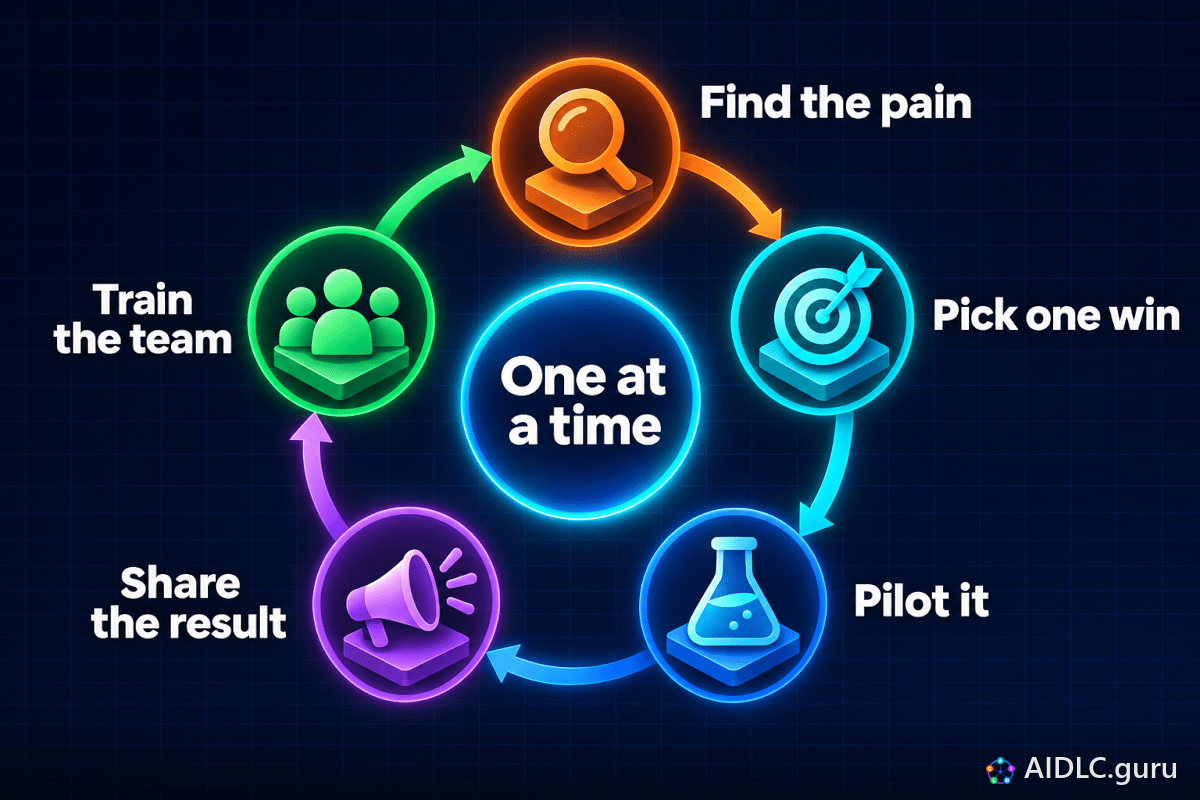
Crawl, Walk, Run lays out the full sequence, and the Rollout Playbook gives the timeline for an organization.
The Playbook
Nineteen pages, each covering one part of the operating model in depth.
The AI-Native SDLC
Seven pillars: context and measurement first, then five workflow shifts from planning to maintenance.
The Productivity Paradox
Faros, DORA, and METR data on why individual speed does not equal organizational throughput.
Hidden Risks
The risk table behind AI-authored code, with CodeRabbit, GitClear, and security research.
Maturity Model
Levels 0 through 4, plus an interactive self-assessment for where your team stands.
Governance Before Scale
Five pillars, a policy outline, and a vendor evaluation checklist.
Engineering Practices
Context engineering, the ticket contract, plan-first work, mutation testing, and the merge queue.
AI Code Review at Scale
The review layer, versioned standards, reviewer fatigue, and measuring review quality.
Agents in the Pipeline
Identity, permissions, sandboxing, budget, and hard rules for agent workloads.
Agent Orchestration
The state machine, dual review, and provable gates that conduct a whole fleet of agents.
Security and Compliance
The OWASP threat model, data classification, and framework mapping.
Measuring Impact
Baseline first, the metrics to report, the metrics to ignore, and the paradox test.
Cost Model and Build vs Buy
Three cost buckets, unit economics, and four build-versus-buy positions.
Failure Patterns
Twelve common ways AI-assisted delivery goes wrong, and how to spot each one early.
Rollout Playbook
Phase 0 through phase 3, each with its own exit criteria.
Scrum and Kanban
Sprint events, review-based estimation, WIP limits on review, and a Definition of Done for agent work.
Teams and Skills
How roles shift, how juniors still learn, interviewing and upskilling.
Legacy Code
Characterization tests first, strangler fig slices, and safe upgrades on brownfield systems.
Templates and Checklists
The policy outline, ticket contract, PR template, reviewer checklist, and vendor checklist.
Research Library
Every primary source behind this Playbook, with its key finding, in one place.
Where It Fits in AIDLC
The Playbook is not a sixth phase. It is the operating layer underneath all five. Analyze and Ideate apply the ticket contract and the signed intent from requirements and design; Develop runs the agent identity, review, and merge rules from coding and code review; Launch applies the testing, CI/CD, and release guardrails; Curate turns incidents, postmortems, and maintenance work back into the next review rule. The table above breaks down exactly where each phase is strong, where it is weak, and who owns the outcome.
Frequently Asked Questions
The AI SDLC Playbook is an operating model guide to putting AI into requirements, coding, review, testing, CI/CD, release, and operations without trading long-term system health for short-term output. It covers ten operating rules, three eras of AI in software development, and nineteen linked pages on transformation, governance, engineering practices, review, orchestration, security, cost, rollout, teams, and legacy code.
The five AIDLC phases, Analyze, Ideate, Develop, Launch, and Curate, describe where work happens in a project. The Playbook describes how to operate once agents do meaningful work inside each phase: what gets verified, who approves what, and which guardrails apply. The phases are the map; the Playbook is the operating manual for the parts of the map where AI now participates.
Start with the ten rules and the three eras table on this page, then open the card for your role: CTO or VP Engineering, engineering manager or staff engineer, individual contributor, security and compliance, or enterprise and solution architect. Anyone about to cite a productivity number should read the Research Library and the Productivity Paradox page first.
It is written for the people who decide how a team works: CTOs and VPs of engineering, engineering managers, staff engineers and tech leads, plus the security, compliance and platform teams who have to approve and run it. Individual engineers will get more from the phase guides and Engineering Practices first.
Look for the signs that tools have outrun process: a review queue that keeps growing while engineers say they are faster, no rule for which tool may see which data, pull requests approved without comment, coverage that rises while escaped defects do not fall, agents running on a developer's credentials, and reports that count adoption and not outcomes. Two or more means the operating model is the missing piece.
Move From Rules to Practice
The ten rules above are necessary but not sufficient. See what the productivity data actually shows, then go deeper into the AIDLC phases where agents now do real work.