Learn AIDLC
Master the AI Development Life Cycle with comprehensive training materials, real-world examples, and best practices for implementing AI-Native Software Delivery.
Start with what AIDLC is and the four skills that matter more than prompting, then follow the three-page path for your role. The page also covers the order teams adopt it in, the misconceptions that slow people down, ten terms worth knowing, a deep dive on each phase and a five-day plan that ends with a change you actually shipped.

What is AIDLC?
AIDLC (AI Development Life Cycle) represents a fundamental shift in how we approach software development. Rather than treating AI as a tool you occasionally use, AIDLC integrates AI as a constant collaborator throughout every phase of development.
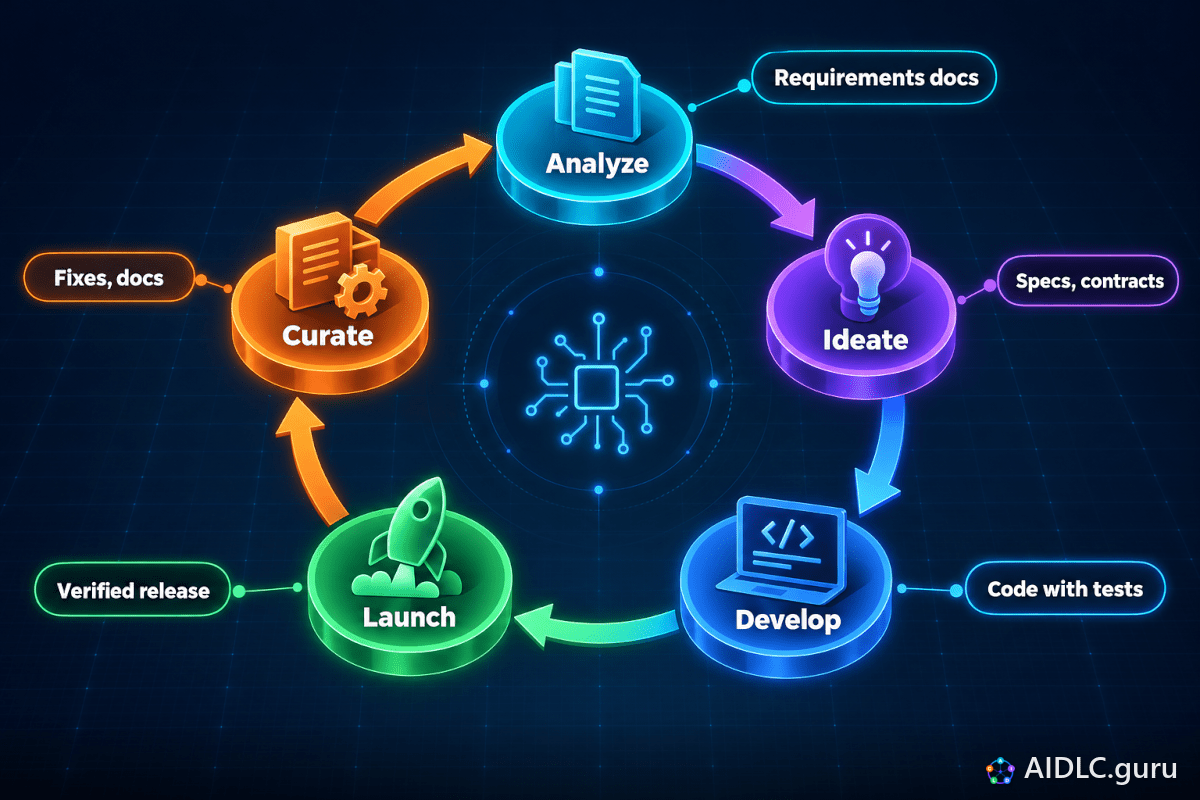
The framework consists of five interconnected phases:
- Analyze - AI-assisted requirements and research
- Ideate - AI-driven design and architecture
- Develop - AI coding agents and code generation
- Launch - AI-powered testing and deployment
- Curate - AI-enhanced monitoring and maintenance
Each phase builds on the previous, creating a continuous cycle of improvement where AI helps at every step.
How AI shows up in those phases has changed. There are three modes, and AIDLC spans all of them: assistant (you prompt, it answers - chat and autocomplete), agent (you scope a task and it plans and executes multiple steps, then hands you a diff to review), and multi-agent (several agents work in parallel under your direction). The shift from assistant to agent is the defining change in AI development - and it makes the human's review and context-setting more important, not less.
Getting Started
Mindset Shift
Stop thinking of AI as a tool you use occasionally. Start treating it as a team member who's always available. This mental shift is the foundation of AIDLC.
Pick One Phase
Don't try to implement all five phases at once. Start with the phase where you see the most friction in your current workflow. Develop is a common starting point, because that is where agent volume is highest.
Iterate & Expand
Once you're comfortable with one phase, gradually add others. Document what works for your team. AIDLC is a framework, not a rigid prescription.
Want to see the whole cycle before you start? The worked example takes one feature from a customer request through all five phases and shows the artifact each phase hands to the next.
Wondering who owns what, or where the tests get written? How the Phases Connect covers the handoffs and the RACI, Testing Strategy covers every test from acceptance criteria to release, and the FAQ has the short answers.
Four Skills That Matter More Than Prompting
Learning AIDLC is mostly learning four habits. None of them is about clever wording, and all four carry over when you change tools. Each one has a page of its own when you are ready for the detail.
1. Define the problem
Say who has the problem, what they need, why it matters and what must never happen. An agent fills every gap with a guess, so a gap you leave is a decision you gave away.
Practice: write the problem in one sentence before you open a tool.
Problem Definition2. Give the right context
Hand the agent the smallest set of files, rules and examples that will do the job. More context is not better; the right context is.
Practice: keep a repo instruction file and point at real files, not descriptions of them.
Context Engineering3. Write testable criteria
State what done means as Given/When/Then. Each criterion becomes a test that exists before the code, so the agent has something to prove.
Practice: for every criterion, ask what test would fail if it were not met.
ACDD4. Review the evidence
Read the plan, the tests and the diff as the person accountable for them. Agent output is plausible by construction, and plausible is not correct.
Practice: approve the plan before the code, and never merge a diff you cannot explain.
AI Code Review at Scale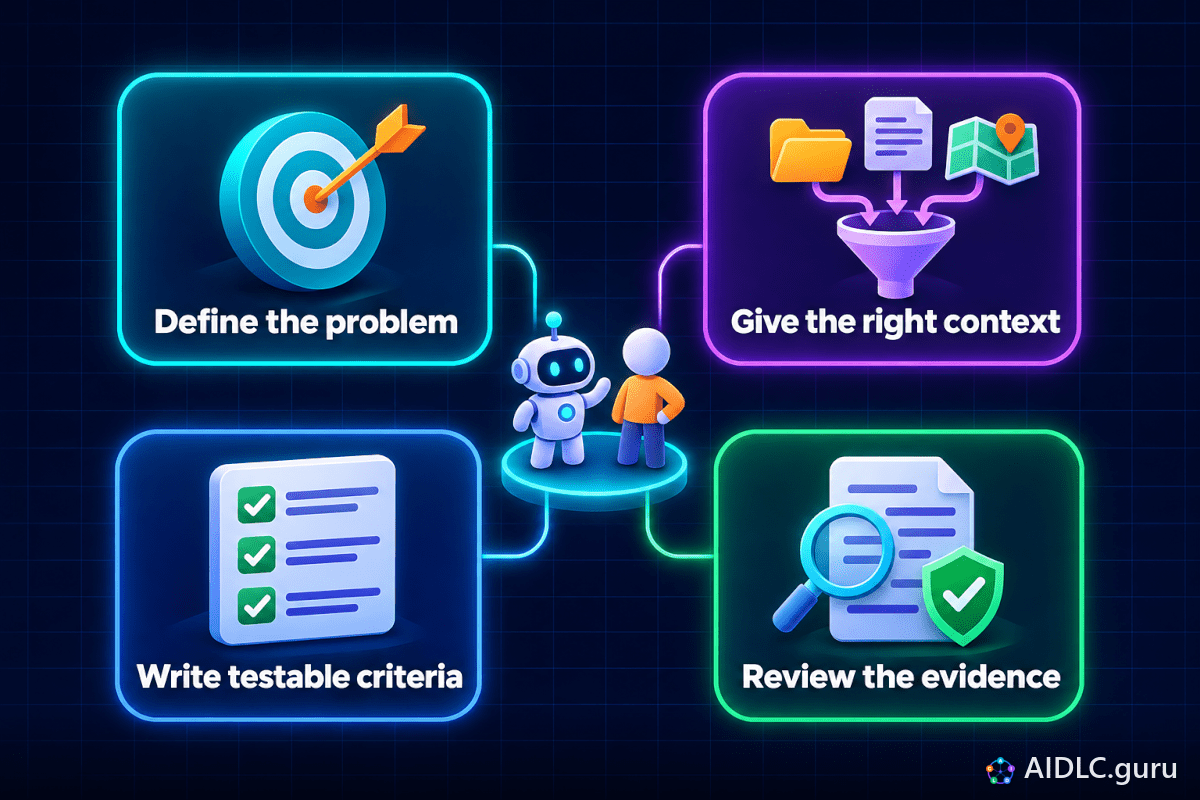
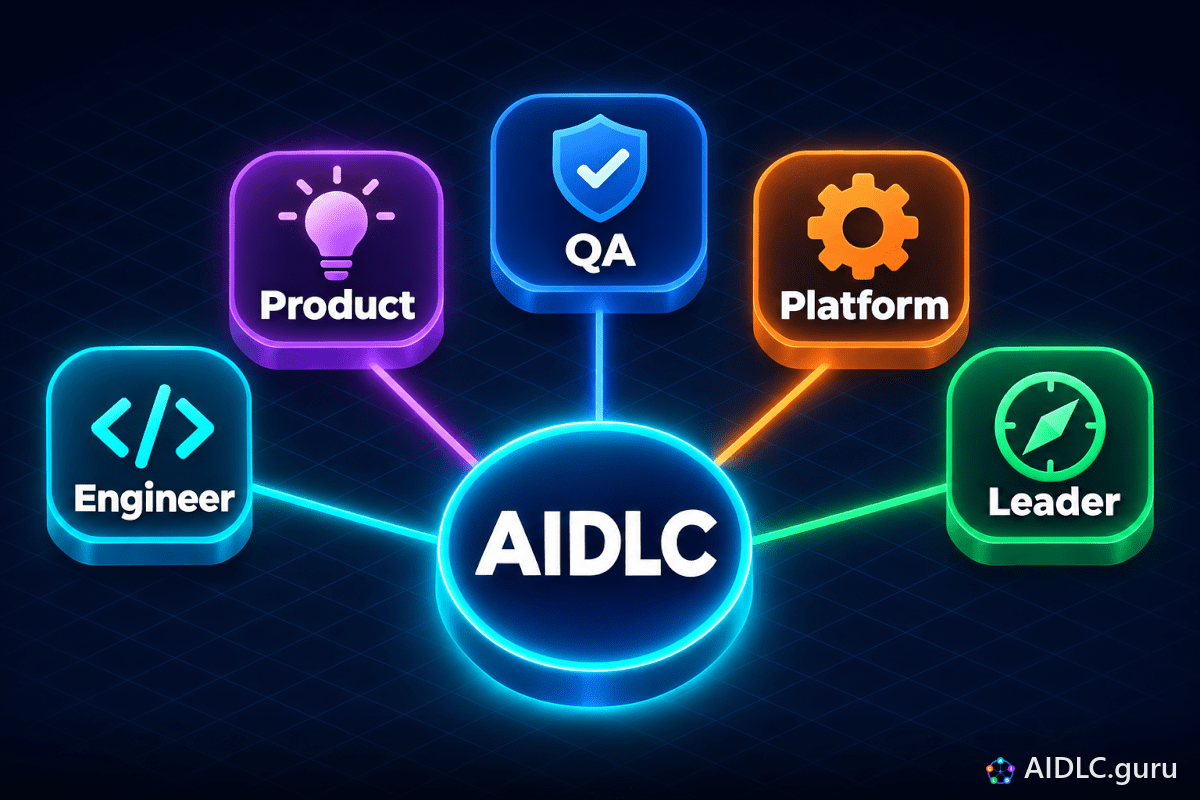
A Learning Path by Role
Nobody needs to read the whole site. Each role has a short path through it: three pages, in order, that cover what changes for you first.
The Order Teams Adopt It In
The five phases run Analyze to Curate, but a team rarely adopts them in that order. Adoption usually starts with the engineers who write code, because their work is already checked by builds, tests and review. It then moves to product, to QA, to deployment, and last to production support.
Each step is taken crawl, walk, run: prove it on a small scale, let the team come to trust it, and only then remove the next manual step.
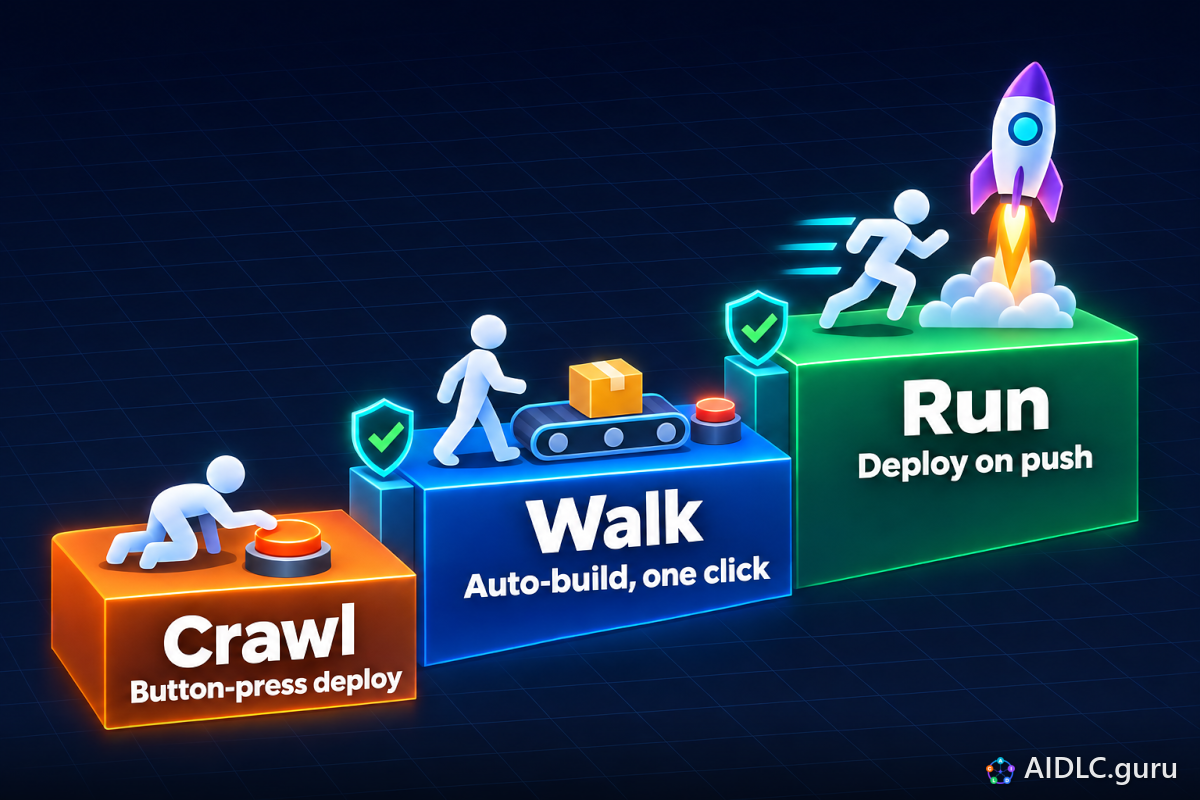
Crawl, Walk, Run covers the whole sequence, and Your First 30 Days covers the first step week by week.
Common Misconceptions
"AIDLC is a tool you install"
It is a way of working. Any capable coding agent fits inside it, and swapping one for another does not change the phases, the artifacts or the gates.
"The agent replaces the review"
The opposite. Code gets cheaper to write, so checking it becomes the main work. A person still owns every merge.
"It only changes how engineers work"
Engineers feel it first, but the largest gains come when product writes clearer problems and QA stops running regression by hand.
"It is waterfall with a chatbot"
The phases are a loop that one small change can travel in a day. They describe the order of thinking, not a schedule of sign-off meetings.
"Better prompts are the skill"
Prompts matter less than what surrounds them: a clear problem, the right context and criteria a test can check.
"We have to adopt all five phases at once"
Almost nobody does. Start with one phase and one team, and add the next when the first has earned trust.
AIDLC in Ten Terms
Ten words carry most of the conversation. Learn these and the rest of the site reads easily. Each one links to its full entry in the Glossary.
| Term | What it means | Where you meet it |
|---|---|---|
| Agent | An AI system that takes a goal and carries out several steps to reach it, then hands back work for review. It acts; an assistant only answers. | Every phase |
| Context engineering | Choosing what an agent sees: the smallest set of intent, criteria, code and rules that will do the job. | Ideate, Develop |
| Instruction file | A file at the root of the repo that an agent reads every session: how to build and test, the conventions, and what never to touch. | Develop |
| Ticket contract | A ticket written so a machine can test against it, with structured acceptance criteria, a risk tier, a feature flag and a rollback plan. | Analyze to Develop |
| Plan approval | A person approves the agent's plan before any code is written, instead of meeting the design for the first time in a long diff. | Develop |
| Risk tier | A class given to a change by how much damage it could do. It sets how deep the review goes. | Develop, Launch |
| Mutation score | The share of deliberately injected bugs that the tests catch. It exposes tests that assert nothing, which coverage cannot. | Develop, Launch |
| Eval | A set of real cases with known-good outcomes, run every time a prompt, an agent or the model behind it changes. | Launch, Curate |
| MCP | The Model Context Protocol, a standard way to connect an agent to your tools, data and systems through a governed interface. | Every phase |
| Vibe coding | Prompting loosely and accepting whatever comes back without real review. It is what AIDLC exists to prevent. | Nowhere, by design |
Deep Dive: The Five Phases
Analyze Phase
AI-Assisted Requirements & Research
The Analyze phase transforms how you gather and process information before development begins. Instead of manually reading through documentation and stakeholder inputs, AI helps synthesize large volumes of information quickly.
Key Activities:
- Requirements extraction from stakeholder conversations
- Research synthesis across multiple sources
- Competitive analysis and market research
- Feasibility assessment and risk identification
- Gap analysis in existing documentation
Ideate Phase
AI-Driven Design & Architecture
The Ideate phase leverages AI to explore multiple design approaches quickly. Rather than settling on the first architecture that comes to mind, AI helps you evaluate alternatives and document decisions.
Key Activities:
- Architecture diagram generation
- Design pattern recommendations
- API contract definition
- Database schema design
- Technical specification writing
Develop Phase
AI Coding Agents & Code Generation
The Develop phase is where AI does the most visible work. It has moved beyond autocomplete: you scope a task, a coding agent plans and executes it across multiple files, and you review the diff. Your job shifts from typing every line to giving good context, steering the agent, and owning the review.
Key Activities:
- Delegating scoped tasks to coding agents
- Writing unit, integration and contract tests from the acceptance criteria before the code
- Reviewing and steering agent-generated diffs
- Real-time code generation and completion
- Refactoring, bug fixing, and code explanation
- Connecting agents to your tools and context via MCP
Launch Phase
AI-Powered Release Assurance & Deployment
The Launch phase reduces the friction between writing code and getting it to production. The unit, integration and contract tests already exist - Develop writes them before the code - so AI runs that suite against the integrated release, looks for gaps, configures CI/CD pipelines, and validates releases.
Key Activities:
- Full-suite and mutation re-checks on the integrated release
- CI/CD pipeline configuration
- Deployment script generation
- Release validation and smoke testing
- Rollback plan creation
Curate Phase
AI-Enhanced Monitoring & Maintenance
The Curate phase ensures your software remains healthy after launch. AI helps monitor, debug, and continuously improve the system while keeping documentation current.
Key Activities:
- Intelligent log analysis and alerting
- Root cause analysis for incidents
- Performance optimization recommendations
- Documentation updates as code evolves
- Technical debt identification
Best Practices
Do: Provide Context
Always give AI the context it needs. Share your codebase structure, coding standards, and project requirements. The more context AI has, the better its suggestions.
Don't: Blindly Accept Output
Always review AI-generated code. Treat it like code from a junior developer - helpful but needs verification. You're responsible for the final quality.
Do: Iterate on Prompts
If the first response isn't what you need, refine your prompt. Be more specific, provide examples, or break the task into smaller pieces.
Don't: Skip Human Review
AI can miss edge cases, introduce subtle bugs, or make assumptions that don't fit your needs. Human code review remains essential.
Do: Document AI Decisions
When AI helps make architecture decisions, document the reasoning. Future team members need to understand why choices were made.
Don't: Ignore Security
AI may generate code with security vulnerabilities. Always run security scans and review AI code for common issues like injection attacks.
Go Further: The Operating Model
The five phases above describe the workflow: what AI does at each stage of building software. The Playbook describes how an organization adopts that workflow safely - governance before scale, review that holds up at agent volume, agents running as identities in CI, the metrics that separate real gains from busywork, and the cost model behind it.
Tools & Setup
AIDLC is tool-agnostic. Here are some popular options for each phase - increasingly connected to your own systems through MCP (the Model Context Protocol). For a deeper look at the agentic tool landscape, see the AI Agents & Tools guide.
| Phase | Recommended Tools | Purpose |
|---|---|---|
| Analyze | Claude, ChatGPT, Perplexity, Gemini Notebook | Research, requirements extraction |
| Ideate | Claude, Gemini, Mermaid, Excalidraw | Architecture, diagrams, specs |
| Develop | Claude Code, Cursor, Copilot, Codex | Agentic coding, tests first, review, refactoring |
| Launch | Claude Code, GitHub Actions, Codex | Release assurance, CI/CD config |
| Curate | Claude, Datadog, Sentry, Grafana | Monitoring, debugging, docs |
A Five-Day Plan for Your First Week
Reading about AIDLC teaches the vocabulary. Taking one real ticket through it teaches the method. This plan does both in a working week, about an hour a day, and ends with a change you actually shipped.
Get the map
Read this page and keep the Cheatsheet open. You are done when you can name the five phases and the gate at the end of each.
Watch one feature
Read the worked example from brief to backlog. Notice that every handoff is a document, and that every document has a named owner.
Pick a small ticket
Choose real, low-risk work. Write the one-sentence problem and two or three Given/When/Then criteria using Problem Definition.
Run it tests first
Ask the agent for a plan and approve it. Have it write failing tests from your criteria, then the code that makes them pass. Review the diff and merge it yourself.
Write down one rule
Note where the agent guessed wrong and add one line to your repo instruction file so it does not guess that way again. That is the Curate loop in miniature.
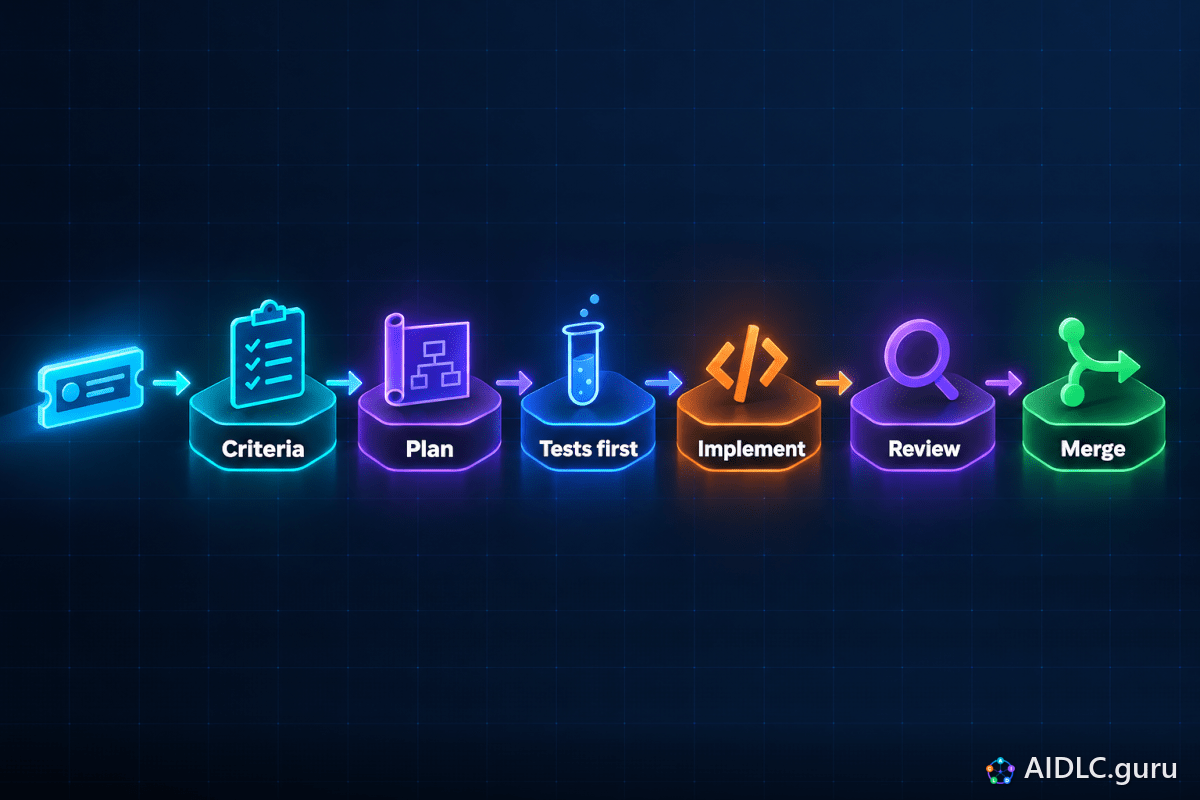
When the week is over, Your First 30 Days turns the same ticket into a team habit, week by week.
Frequently Asked Questions
Take one small, real ticket through the method. Read this page and the cheatsheet for the map, read the worked example to see every handoff, then write a one-sentence problem and a few Given/When/Then criteria for a low-risk change. Have an agent write the tests before the code, review the diff yourself, and write down one rule from what went wrong.
Learn the phase closest to your own work. Engineers usually start with Develop, product managers with Analyze, QA with Launch and testing strategy, and platform teams with agents in the pipeline. Teams as a whole tend to adopt Develop first, because code is already checked by builds, tests and review.
The concepts can be learned in an afternoon: five phases, the artifact each one hands to the next, and the rule that tests come before code. Putting them into practice is a rollout rather than a course. The Rollout Playbook plans it in overlapping phases over roughly nine months for an organization, while a small team can adopt the core controls far sooner.
No prior AI experience is required. AIDLC teaches you how to effectively collaborate with AI tools as part of your development workflow. The framework is designed for developers at all experience levels.
Ready to Practice?
Grab the cheatsheet for quick reference as you implement AIDLC in your projects.
Get the Cheatsheet