AIDLC The AI Development Life Cycle Framework
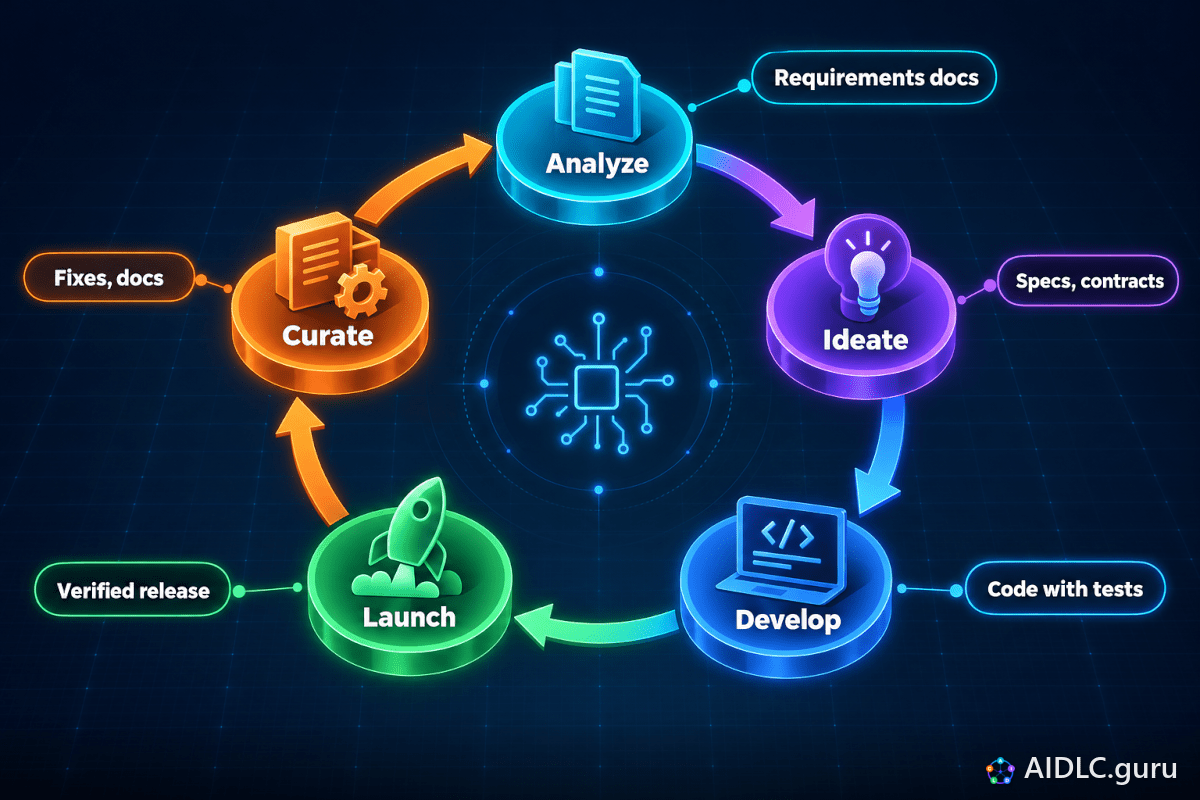
AIDLC is a way of building software in which AI agents draft the work, automated gates verify it, and people decide. It runs in five phases, Analyze, Ideate, Develop, Launch and Curate, and each phase hands a written artifact to the next.
Writing code got cheap. Checking it did not. This site is the free, tool-neutral guide to working that way: phase guides, playbooks, templates and worked examples.
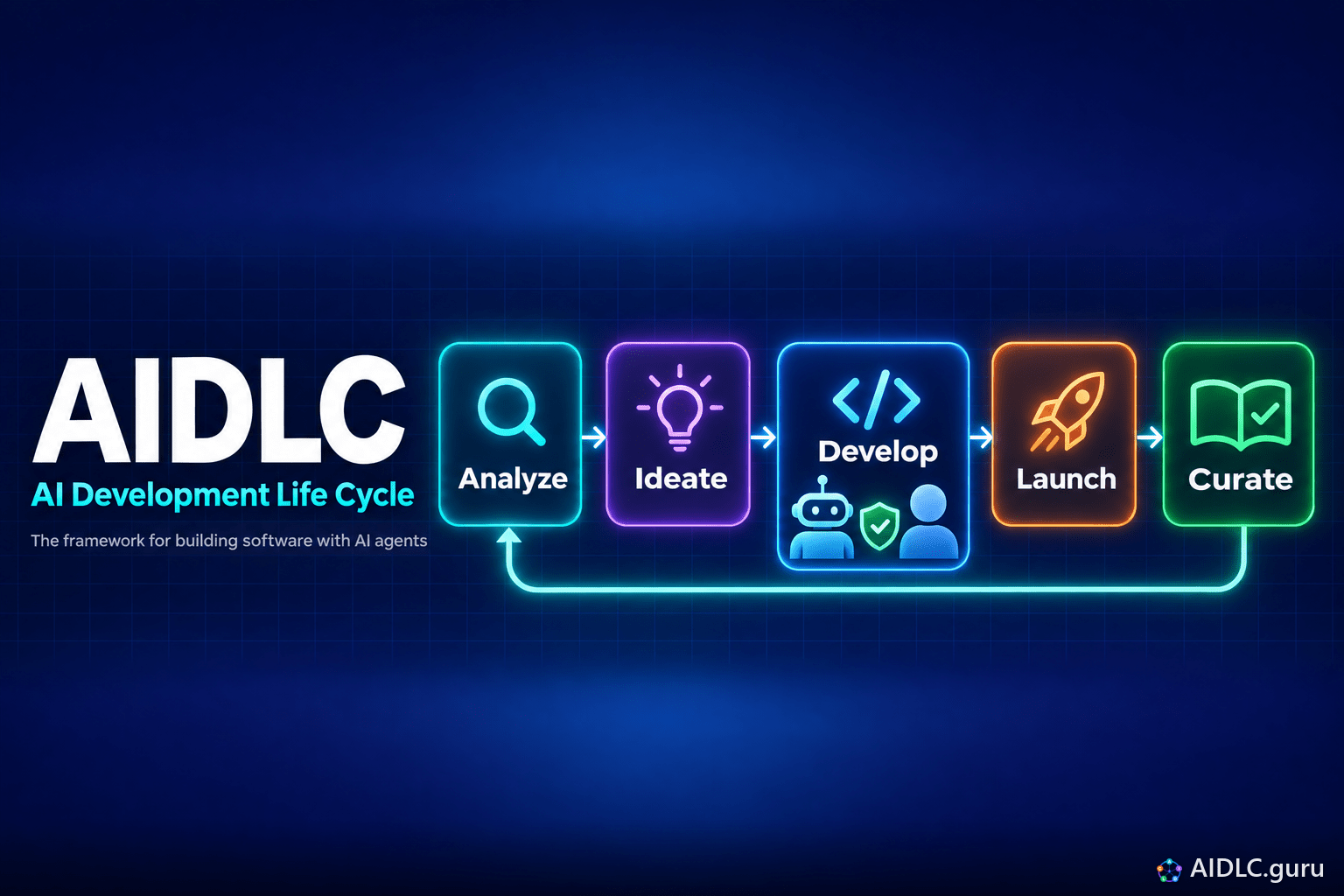
The AIDLC Flow: Five Phases, Five Gates
A continuous cycle. Pick a phase to open its guide.
Start With What Readers Open Most
The eight guides people read most on this site. Pick the question you are trying to answer today.
 Learn AIDLC New here? The whole framework in one read, with a path for your role. Start the guide
 The Cheatsheet Phases, gates, owners and the ten rules on one page, with a printable PDF. Open the cheatsheet
 The Analyze Phase Turn a vague request into a requirements brief an agent can build from. Write a better brief
 The AI SDLC Playbook The operating model for leaders: ten rules, governance, review and rollout. Read the playbook
 The Develop Phase Tests before code, scoped tasks for agents, and a person who owns the merge. Direct the agents
 The Glossary Agent, harness, eval, MCP, risk tier: every term on this site in plain words. Look up a term
 The Maturity Model Twelve questions that show where your team really stands. Take the assessment
 Engineering Practices Plan first, mutation-scored tests, tiered review and the merge queue. See the practices
SDLC is Dead. Long Live AIDLC.
For decades, we've followed the same Software Development Life Cycle. Requirements. Design. Develop. Test. Deploy. Maintain. It worked. But it was built for a world where AI wasn't a collaborator.
That world is gone.
Traditional SDLC
- Human-only requirements gathering
- Manual architecture documentation
- Solo or pair programming only
- Hand-written tests and CI/CD
- Reactive maintenance
AIDLC
- AI-assisted research and analysis
- AI-driven design exploration
- AI agents that plan and execute multi-step work
- Tests generated before the code, plus pipeline automation
- Proactive AI monitoring
Four Ways Teams Build Software With AI
Most teams are already in one of these. The difference between them is not the model or the tool. It is who writes the work, and how it gets checked before it ships.
| Way of working | Who writes | How it is checked | What happens as volume grows |
|---|---|---|---|
| Traditional SDLC | People | People read every line | It holds, at the speed people can type and read. |
| Vibe coding | Agents | Nobody checks | Fast until the first defect nobody can explain. |
| AI bolted on | Agents | People still read every line | Pull requests pile up and review becomes the bottleneck. |
| AIDLC | Agents draft | Gates verify, and a named person decides | Review effort follows the risk, so it keeps up. |
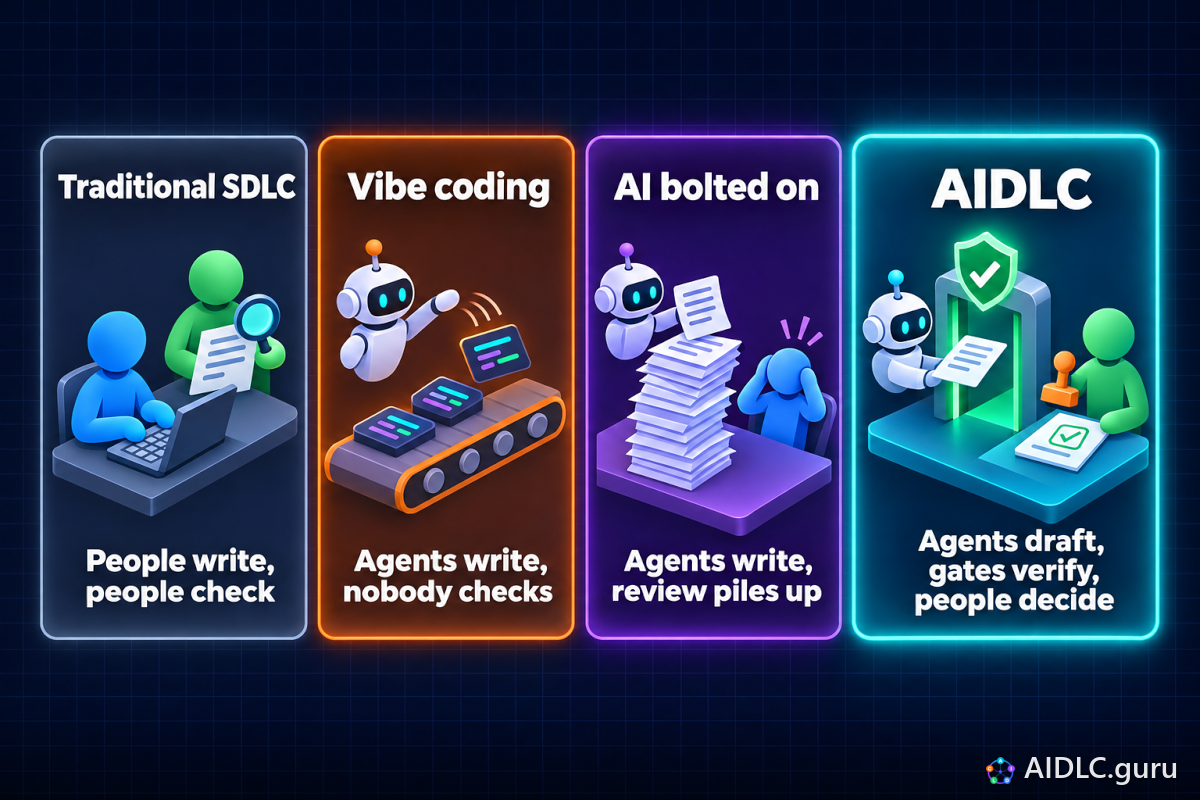
The stage-by-stage comparison is on AIDLC vs SDLC, and the evidence for the bottleneck is on The Productivity Paradox.
Five Phases. AI-Integrated Throughout.
A complete methodology for modern software delivery where AI amplifies human capability at every step.
Analyze
AI-assisted requirements gathering, research synthesis, feasibility analysis, and stakeholder alignment. Let AI surface insights from documentation, past projects, and domain knowledge.
Ideate
AI-driven architecture design, documentation generation, and solution modeling. Explore possibilities, generate alternatives, and validate approaches before writing code.
Develop
Direct AI coding agents that plan multi-step tasks, write the tests from the acceptance criteria before the code, generate and refactor code until those tests pass, and open reviewable diffs. The developer's job shifts from typing every line to scoping work, steering agents, and owning the review - amplifying developers, not replacing them.
Launch
Verify the integrated release against the tests Develop wrote, add the checks only a release can have - smoke tests, health checks, a rehearsed rollback - and automate CI/CD, deployment, and release validation. Reduce friction from commit to production with AI handling the operational complexity.
Curate
AI-powered monitoring, intelligent debugging, continuous documentation, and iterative improvement. Maintain and evolve systems with AI as your constant partner in quality.
People, Agents and Gates
Every phase works the same way. An agent drafts, a gate verifies, and a person decides. Knowing which of the three is acting at any moment is most of what it takes to read the rest of this site.
Agents draft
Agents produce the first version of nearly everything: the requirements brief, the design options, the tests, the code, the release notes, the incident summary.
An agent is never accountable for the result. It proposes; it does not approve its own work.
Gates verify
A gate is a check that runs the same way every time: the test suite, the security scan, the policy rule, the exit criteria of a phase.
Gates are what let a team accept agent-written work at volume without reading every line twice.
People decide
A named person signs the brief, chooses the design, owns the merge and approves the release. Judgment, trade-offs and accountability stay human.
What a person decides goes back to the agent as context for the next draft.
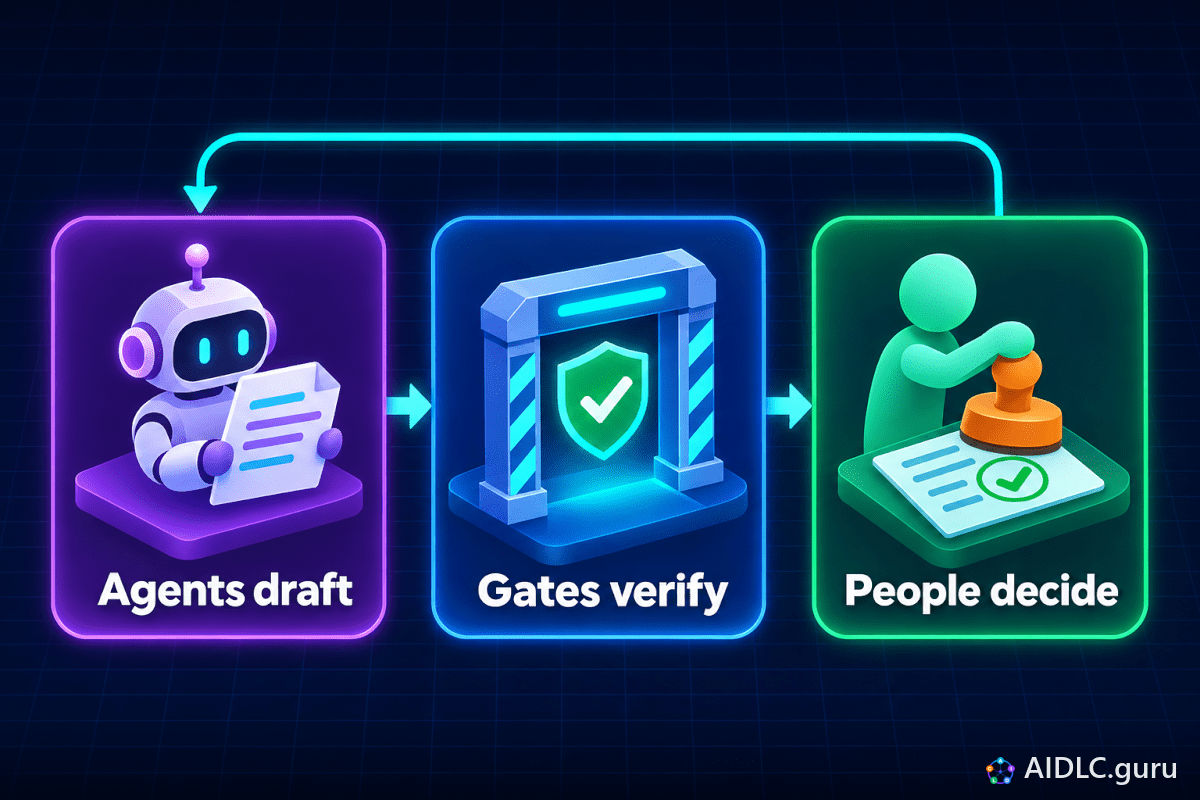
The owners and handoffs for every artifact are in How the Phases Connect.
What Each Phase Hands to the Next
AIDLC is held together by documents, not meetings. Each phase ends by handing a written artifact to the next one, and the next phase may rely only on what is written there.
| Phase | The question it answers | What it hands on | Who signs it |
|---|---|---|---|
| Analyze | What problem are we solving, and for whom? | Requirements brief | Product owner |
| Ideate | How will we solve it? | Design note, decision record, contract and spec | Tech lead |
| Develop | Does the code meet the criteria? | Ticket contract, plan, tests and a reviewed pull request | The engineer who merges |
| Launch | Is the integrated release safe to ship? | Verified release and release plan | Release owner |
| Curate | What did production teach us? | Runbook, review and a new rule for the agents | Service owner |
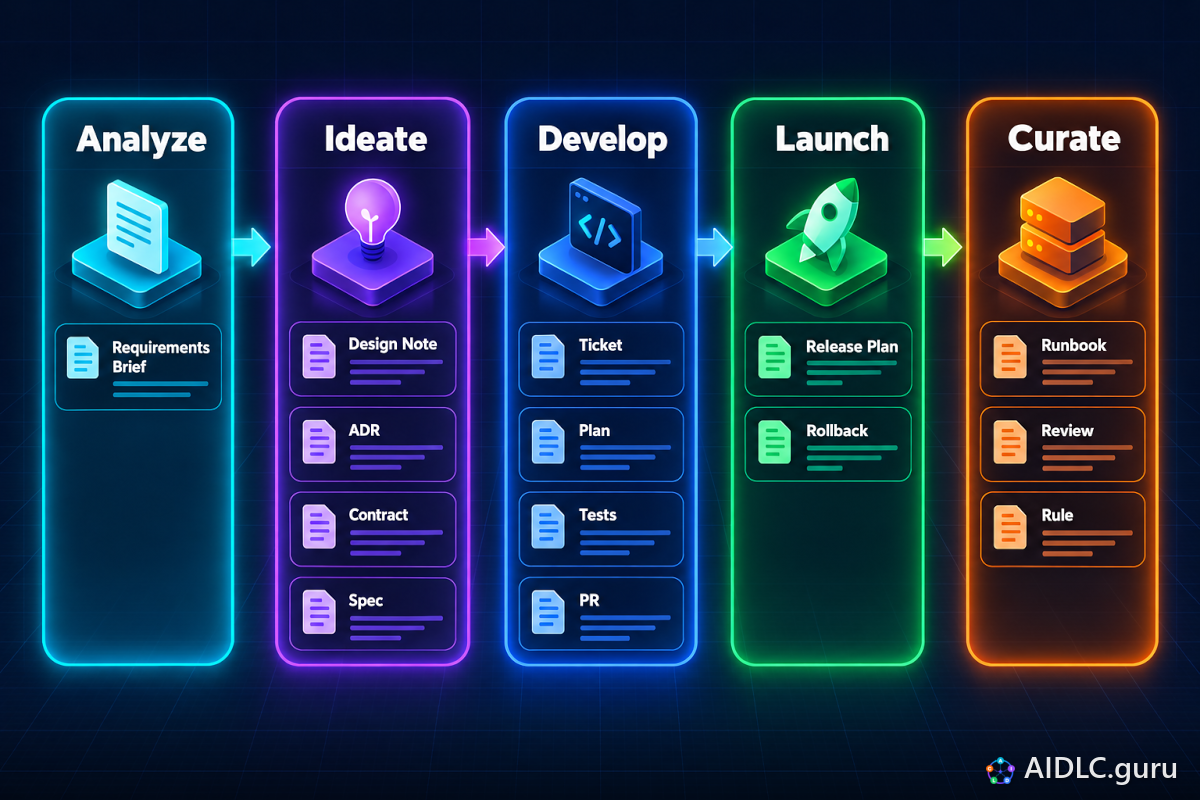
The worked example follows one feature through this whole chain.
Why Teams Choose AIDLC
Faster Delivery
Reduce time-to-market with AI accelerating every phase of development.
Higher Quality
AI-assisted code review and testing catch issues before they reach production.
Better Decisions
AI surfaces insights and alternatives you might have missed.
Team Amplification
AI doesn't replace developers - it makes them more effective.
Living Documentation
AI keeps documentation current as your codebase evolves.
Continuous Learning
Each iteration improves your AI's understanding of your codebase.
Where to Start: Crawl, Walk, Run
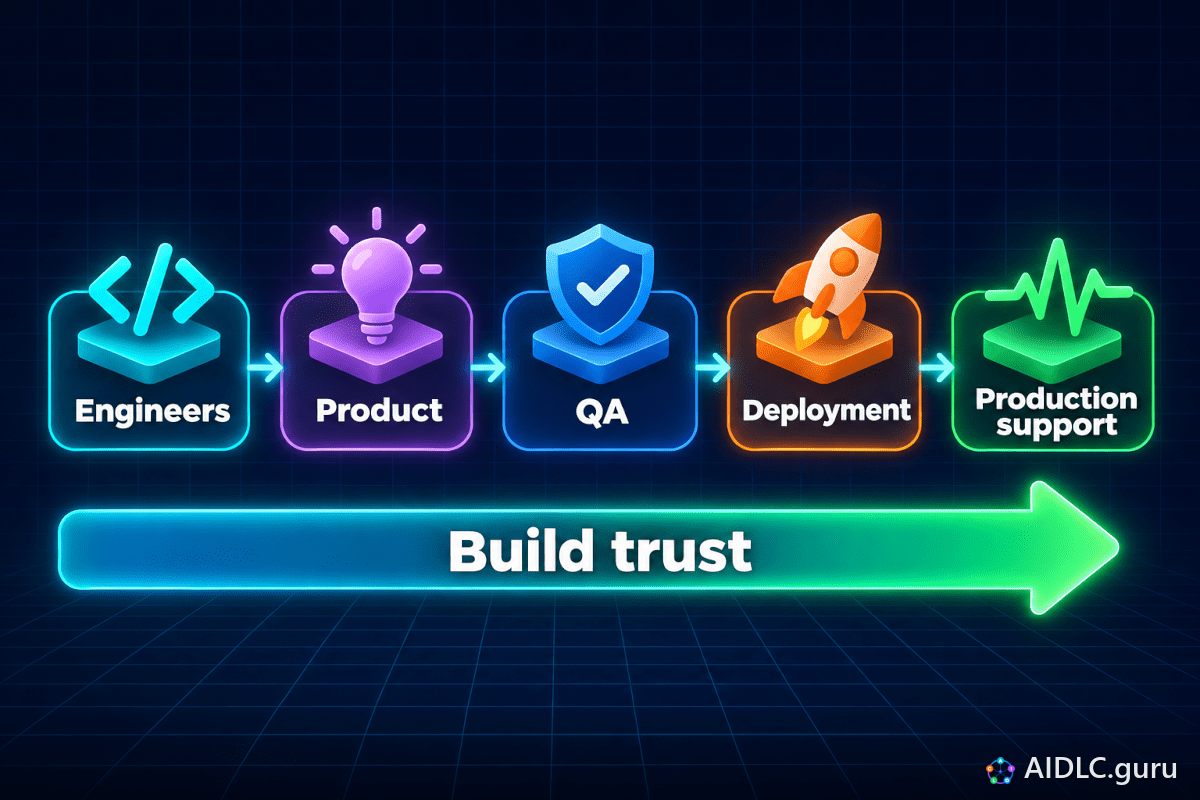
The question engineering leaders ask most is how to break into AIDLC when a team is used to the old way of working. Adopt it in this order, and build trust at each step before taking the next.
Start with the people who write code. Feedback is fast and the existing review process catches mistakes.
Use AI to research, define the details and explain the problem being solved in each story.
Generate automated tests from the acceptance criteria and retire manual regression testing.
Move from a button press, to an automatic build that waits for one click, to deploying on push.
Extra credit: an AI agent as the first line of production support.
Adopting AI Is an Operating Model Change, Not a Tooling Purchase
Authoring got cheap. Verification, integration, and merge capacity are now the constraint. Organizations that design for that constraint capture the gain; organizations that bolt agents onto authoring alone double their PR volume and drown.
The Playbook
Ten rules, three eras, and the map for where AI touches every phase.
Read the playbookThe Productivity Paradox
What the telemetry shows about individual output versus organizational throughput.
See the dataMaturity Model
A 12-question self-assessment for where your team really stands.
Take the assessmentEngineering Practices
Plan first, mutation-scored tests, and tiered review.
See the practicesAgents in the Pipeline
Identity, permissions, and the hard rules for running agents in CI.
Read the rulesTemplates and Checklists
Copy and adapt: policy outline, ticket contract, PR template, reviewer checklist.
Get the templatesReady to Transform Your Development?
Start implementing AIDLC today. The developers who thrive aren't the ones who fear AI - they're the ones who learn to direct it, reviewing and steering agents across every phase of delivery.
Frequently Asked Questions
AIDLC (AI Development Life Cycle) is a modern framework for software development that integrates AI throughout every phase of the development process. It consists of five phases: Analyze, Ideate, Develop, Launch, and Curate - each enhanced by AI capabilities to improve speed, quality, and developer experience.
AIDLC stands for AI Development Life Cycle. The five letters are also its five phases: Analyze, Ideate, Develop, Launch and Curate. Each phase ends at a gate and hands a written artifact to the next one, and Curate loops back to Analyze.
No. They share an acronym but not a shape. AWS's AI-DLC is AWS's own delivery methodology, installed as workflows inside a coding agent. The AIDLC framework on this site is an independent, tool-neutral lifecycle of five phases: Analyze, Ideate, Develop, Launch and Curate. The two can be used together.
No. AIDLC is designed to amplify developer capabilities, not replace them. AI serves as a tireless collaborator that handles repetitive tasks, surfaces insights, and accelerates workflows - while humans remain in control of architecture decisions, creative problem-solving, and final quality assurance.
Traditional SDLC was organized around the cost of people writing code. AIDLC is organized around the cost of people verifying code that agents write. The stages map closely, but tests move before the code, requirements and specs become contracts that agents read, review scales by risk tier, and every incident feeds a rule back into the cycle instead of ending at a fix.
AIDLC is tool-agnostic. You can use chat assistants like Claude, ChatGPT, or Gemini and coding agents like Claude Code, Cursor, GitHub Copilot, or Codex - increasingly connected to your own systems through MCP (the Model Context Protocol). The framework focuses on methodology - how you integrate AI into your workflow - rather than prescribing specific tools. Most teams use several across different phases.
No. AI has shifted from autocomplete to autonomous agents that plan and execute multi-step work, and vibe coding - accepting whatever an agent produces without review - is exactly what AIDLC guards against. AIDLC keeps humans accountable for specs, architecture, and the review of every agent diff. The skill that matters now is directing agents with clear context and verifying their output, not typing every line yourself.
Start with the Learn section to understand each phase in depth. Then grab the Cheatsheet for quick reference. Begin by introducing AI into one phase of your current workflow, then gradually expand to all five phases as your team builds confidence.